

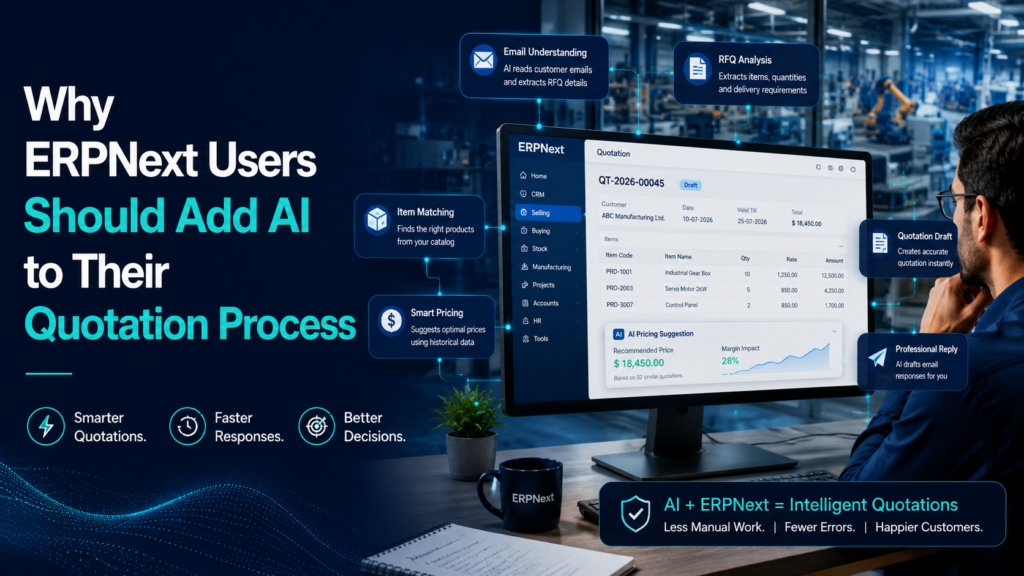
Why ERPNext Users Should Add AI to Their Quotation Process
ERPNext has earned its reputation as one of the world’s most capable open-source ERP platforms. Thousands of manufacturers, distributors, and service organizations rely on it every day to manage sales, purchasing, inventory, accounting, production, and customer relationships.
However, while ERPNext excels at organizing business information, many quotation workflows still depend heavily on manual effort.
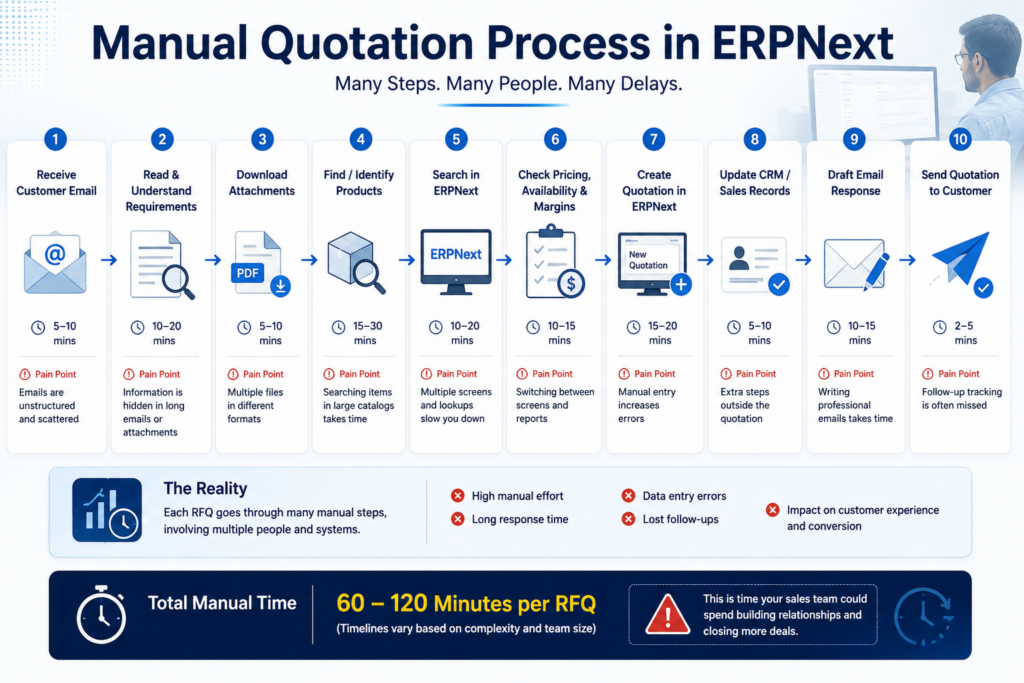
Sales teams often spend valuable time reading customer emails, downloading attachments, searching for products, checking pricing, preparing quotations, updating ERP records, and following up with customers. These repetitive activities slow response times and reduce the amount of time sales professionals can dedicate to building customer relationships.
Artificial Intelligence introduces a new way of working—not by replacing ERPNext, but by making it significantly more intelligent. Please also read How AI is Transforming RFQ Management in Manufacturing.
ERPNext Is Powerful—But Your Team Is Still Doing Too Much Manual Work
Consider a typical quotation request.
A customer sends an email with several attachments containing product specifications.
Someone from the sales team must:
- Read the email
- Download attachments
- Understand customer requirements
- Identify the correct products
- Search ERPNext for item codes
- Verify pricing
- Create the quotation
- Update CRM information
- Draft the reply
- Send the quotation
While each step may only take a few minutes, together they can consume an hour or more for a single enquiry.
As enquiry volumes increase, so do administrative workloads.
The result is slower customer responses, increased pressure on sales teams, and a greater risk of mistakes.
AI Complements ERPNext Rather Than Replacing It
One common misconception is that AI should replace an ERP system.
In reality, ERPNext remains the system of record.
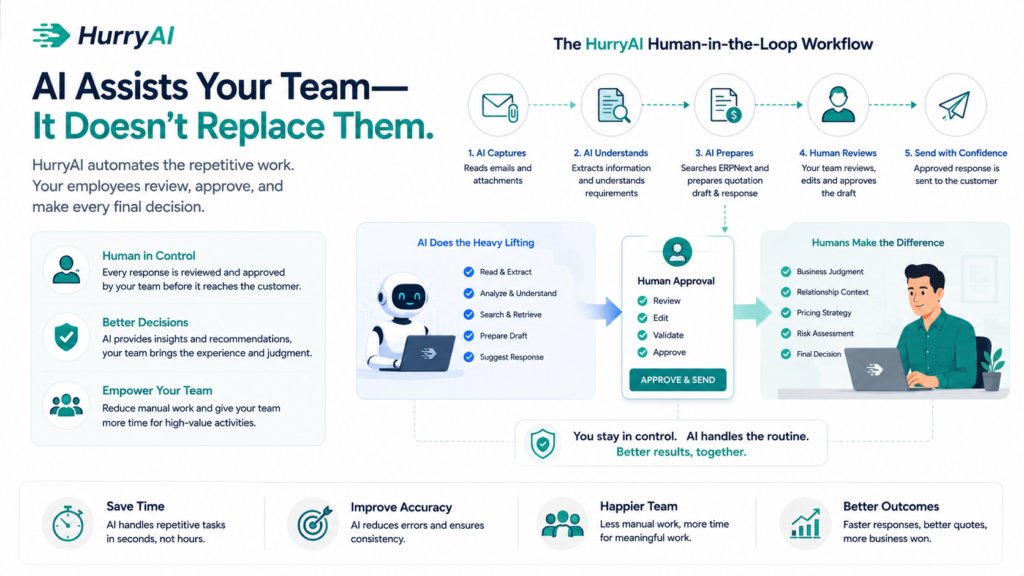
AI acts as an intelligent assistant that understands information, performs repetitive work, and prepares recommendations for human review.
Instead of replacing ERPNext, AI enhances how people interact with it.
1. Transform Customer Emails into Quotations Automatically
Most quotation processes begin with an email.
Instead of manually copying customer requirements into ERPNext, AI can understand the email, identify RFQ requests, extract information from attached PDF or Office documents, and organize the information into a structured format.
An AI assistant can then:
- Identify the customer
- Create or update CRM records
- Capture requested products
- Extract quantities and delivery requirements
- Prepare a quotation draft
What once required multiple manual steps can be prepared within minutes, allowing the sales team to focus on reviewing rather than retyping information.
2. Smarter Pricing Recommendations
Pricing is one of the most important decisions in every quotation.
Pricing too high may reduce the likelihood of winning the order.
Pricing too low may affect profitability.
AI can support decision-making by analysing historical quotations, customer purchasing behaviour, previous discounts, seasonal demand, and product margins.
Instead of replacing pricing decisions, AI provides recommendations that help sales professionals make more informed choices while maintaining commercial control.
Future AI capabilities may even recommend alternative products or suggest bundled offerings that improve both customer value and business profitability.
3. Intelligent Product Identification
Manufacturers often maintain thousands of products, variants, spare parts, and assemblies.
Finding the correct item code can become surprisingly time-consuming.
AI can understand customer descriptions written in natural language and recommend the most relevant ERPNext items.
Instead of searching manually through extensive catalogues, users receive intelligent suggestions based on previous quotations, customer history, specifications, and similar products.
This reduces quotation preparation time while improving consistency and reducing errors.
4. AI-Assisted Customer Follow-Ups
Preparing quotations is only part of the sales process.
Many opportunities are lost simply because nobody follows up at the right time.
AI can continuously monitor quotation activity and identify opportunities that require attention.
Examples include:
- Quotations awaiting customer response
- Quotations nearing expiry
- Customers who frequently request quotations but rarely place orders
- High-value quotations requiring management attention
AI can prepare personalised follow-up emails for review, helping sales teams maintain consistent customer communication without increasing administrative effort.
5. Learn from Every Quotation
Every quotation contains valuable business intelligence.
Over time, AI can analyse quotation history to answer important business questions, such as:
- Which products generate the highest win rates?
- Which customers negotiate the largest discounts?
- Which sales representatives close quotations most efficiently?
- Which quotation values convert most successfully?
- How long does it typically take to respond to different types of RFQs?
These insights help businesses continuously improve their sales strategies.
Human Expertise Remains Essential
Successful quotations require experience, commercial judgement, and customer understanding.
AI cannot replace those qualities.
Instead, it removes repetitive administrative work so experienced professionals can focus on solving customer problems and building stronger relationships.
The most effective implementations follow a Human-in-the-Loop approach, where AI prepares recommendations while people make the final decisions.
This combination delivers both speed and confidence.
A Roadmap for AI-Enhanced ERPNext
ERPNext already provides an excellent foundation for business operations.
The next step is making everyday workflows more intelligent.
As AI capabilities mature, ERPNext users can expect increasingly powerful assistants that help automate repetitive work while preserving human oversight.
Potential capabilities include:
- Email-to-Quotation automation
- AI-powered RFQ understanding
- Intelligent product identification
- Pricing recommendations based on historical data
- Margin optimisation suggestions
- Quotation drafting assistance
- AI-generated follow-up emails
- Quotation priority scoring
- Quote expiry reminders
- Customer buying pattern analysis
- Sales forecasting based on quotation trends
- Natural language search across ERPNext records
- Voice-enabled ERP interactions
- AI-generated sales summaries and dashboards
Together, these capabilities can transform ERPNext from a system that stores business data into an intelligent platform that actively supports business decisions.
How HurryAI Fits In
HurryAI is being developed with exactly this vision in mind.
Rather than replacing ERPNext, HurryAI works alongside it to automate repetitive tasks, assist decision-making, and accelerate quotation workflows.
Our vision is to provide AI assistants that can:
- Read customer emails and RFQs
- Understand attachments automatically
- Prepare quotation drafts
- Suggest pricing and product selections
- Update ERPNext records intelligently
- Generate professional customer responses
- Recommend next actions for sales teams
- Keep humans in complete control of every important business decision
By combining the operational strength of ERPNext with practical AI assistance, businesses can improve response times, reduce manual work, and create better customer experiences.
Final Thoughts
ERPNext has already transformed how businesses manage their operations.
The next opportunity is transforming how people work with ERPNext.
By integrating AI into quotation workflows, organizations can respond faster, improve accuracy, make better pricing decisions, and free their teams to focus on customers instead of repetitive administration.
The future of ERPNext is not simply better automation—it is intelligent collaboration between people and AI.