


How AI is Transforming RFQ Management in Manufacturing
Manufacturing businesses thrive on speed, precision, and customer trust. Yet one of the most critical processes in the sales cycle—responding to Requests for Quotations (RFQs)—is still heavily dependent on manual work in many organizations.
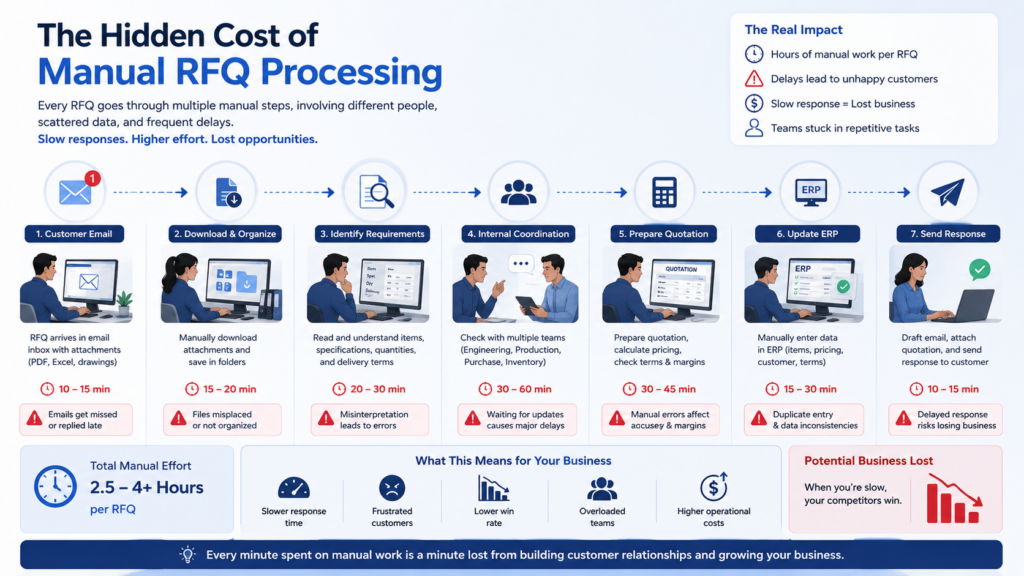
Every day, sales and operations teams receive customer enquiries through email. Someone reads the message, downloads attachments, identifies product requirements, consults internal teams, prepares quotations, updates the ERP system, drafts a response, and finally sends it back to the customer. While this process may seem routine, it often consumes hours of valuable time and creates unnecessary delays.
The challenge isn’t simply the amount of work involved. The real problem is that every delay increases the risk of losing business. Customers expect quick, accurate responses, and when quotations take too long, they frequently move on to suppliers who respond faster.
The Hidden Cost of Manual RFQ Processing
Many organizations underestimate how much time is spent on repetitive administrative tasks.
A typical RFQ process often includes:
- Reading customer emails
- Downloading and organizing attachments
- Identifying requested products
- Extracting technical specifications
- Checking inventory or pricing
- Coordinating with engineering or procurement teams
- Preparing quotation documents
- Updating ERP records
- Drafting customer responses
Each of these activities may only take a few minutes, but together they can occupy several hours for every quotation request. As business grows, these repetitive tasks consume an increasing share of the team’s day, leaving less time for customer engagement, strategic planning, and business development.
Why Traditional Automation Falls Short
Many businesses have already implemented ERP systems to manage inventory, procurement, production, and finance. While these systems are excellent at storing and organizing business data, they often depend on people to enter information manually.
Similarly, traditional workflow automation tools can move information between systems, but they generally struggle to understand unstructured emails, interpret customer requirements, or summarize technical documents.
This is where Artificial Intelligence introduces a significant shift.
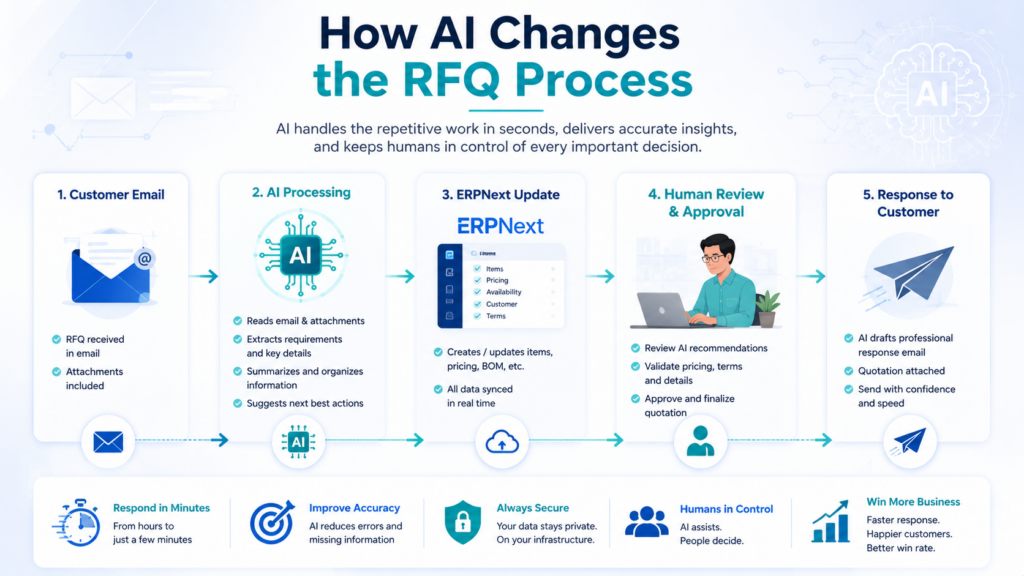
How AI Changes the RFQ Process
Modern AI systems can understand business emails in much the same way a human does.
Instead of simply moving data from one application to another, AI can:
- Read incoming customer emails
- Identify RFQ requests automatically
- Extract important information from PDF and Office documents
- Summarize customer requirements
- Recommend the next actions
- Prepare quotation drafts
- Update ERP systems
- Draft professional customer replies
Most importantly, these activities can happen within minutes rather than hours.
Human Expertise Still Matters
One common misconception about AI is that it replaces people.
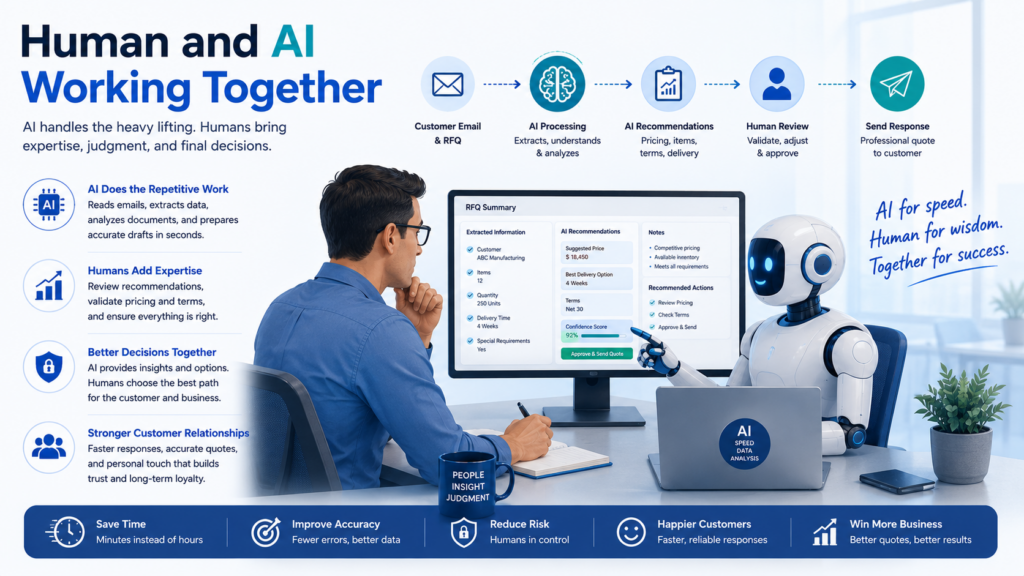
In reality, the most effective enterprise AI solutions follow a Human-in-the-Loop approach.
AI performs repetitive, time-consuming work while experienced professionals review recommendations, validate pricing, and approve quotations before anything reaches the customer.
This combination provides both speed and confidence.
Security Cannot Be an Afterthought
Manufacturing companies handle sensitive information every day, including customer drawings, pricing, supplier data, and intellectual property.
Any AI solution should respect these realities.
Organizations increasingly prefer AI platforms that can operate within their own infrastructure or private cloud, ensuring that confidential business information remains under their control while still benefiting from intelligent automation.
The Future of Manufacturing Sales
AI is no longer just a tool for large enterprises. It is becoming a practical assistant that helps organizations respond faster, reduce repetitive work, and improve customer satisfaction.
As competition continues to increase, manufacturers that combine experienced teams with intelligent automation will be better positioned to deliver exceptional customer experiences while improving operational efficiency.
Where HurryAI Fits In
HurryAI was created to help manufacturers and B2B organizations simplify repetitive quotation workflows through secure, enterprise-ready AI.
Our platform is designed to:
- Understand customer emails and RFQs
- Extract information from attachments
- Prepare quotation drafts
- Assist with ERPNext updates
- Draft professional customer responses
- Keep your team in complete control of every business decision
Rather than replacing people, HurryAI empowers them to focus on solving problems, serving customers, and growing the business.
Final Thoughts
The future of RFQ management is not about working harder—it is about working smarter.
Organizations that embrace intelligent automation today will be able to respond more quickly, improve quotation quality, and create better customer experiences without increasing administrative workload.
AI is changing how manufacturers operate, and RFQ management is one of the areas where its impact is already becoming clear.